Women and university professorships in the 1700s
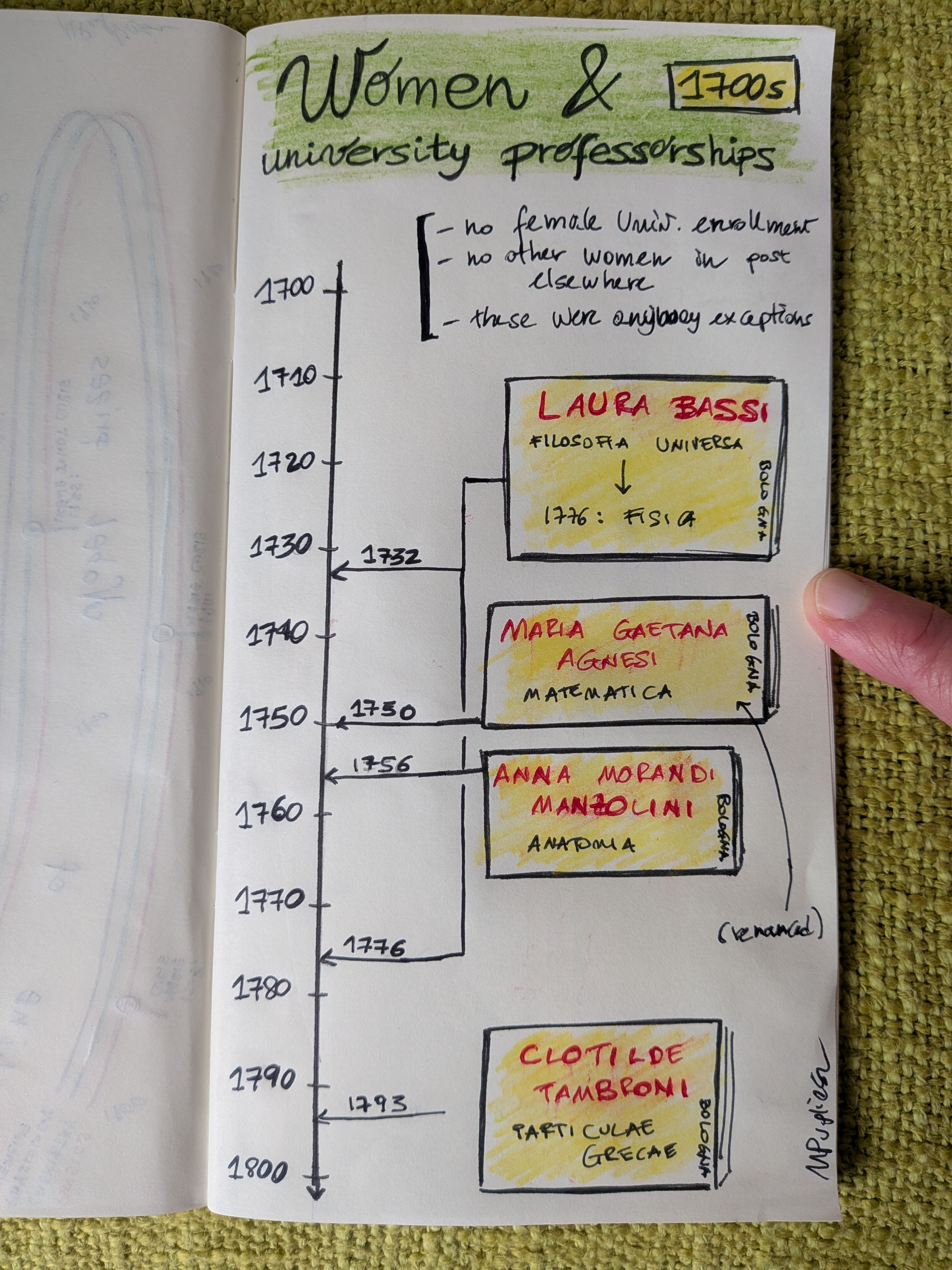
Laura Bassi is known as the first woman ever to obtain a university professorship, if by that we mean a salaried and formal post. In 1732 she became lecturer in Natural Philosophy at the University of Bologna (in the then Papal States), and in 1776 she was further appointed Professor of Physics.
Her breaking of the glass ceiling didn’t however pave a new way for women in academic institutions, because the appointment was one of a small cluster of exceptions, all happening at the same university and in the 18th century:
- Maria Gaetana Agnesi was offered a professorship in Mathematics in 1750 (that she renounced, preferring to devote herself to charity work and private study);
- Anna Morandi Manzolini in 1756 took over a job in the faculty of Anatomy after her husband, with whom she used to collaborate, died;
- Clotilde Tambroni became professor of Greek language and literature in 1793.
It is also important to mention that female students in universities were a grand total of zero, as generally women weren’t even allowed to study, so having a female professor was even more of an extraordinary case.
Bologna had done something highly unusual with these people. No other university in the world at the time had any female lecturer or professor. The fact that the Papal states were somewhat keen to employ women in institutions of high studies (which they controlled) was motivated more by political interest of prestige-hoarding than any willingness to improve equality: these people were high achievers, somewhat famous and well respected in intellectual circles, and they certainly weren’t considered as representative of women in general and their capabilities. Bassi and Agnesi were even mentioned in the “Femme” entry of the Diderot’s Encyclopédie (see here in the digitised version by the University of Chicago).
Some good reads
Other than the references linked in the text above, these are worth your time if you’re interested in the topic:
- D de la Croix, M Vitale, Women in European academia before 1800—religion, marriage, and human capital, European Review of Economic History, 7:4, 2023 - academic paper that explores the contribution of women to academia since the Middle Ages, this is the main reference I’ve used to derive the information in this post
- [ITA] Laura Bassi: Fisica, Accademica, Docente di Filosofia Naturale e Fisica Sperimentale - biography on the website of the University of Bologna (“alumni and famous people” section)
- [ITA] Clotilde Tambroni, Linguista, Accademica, Poeta, Professoressa di Lingua e Letteratura greca - same as above for Tambroni
- Laura Bassi, Enlightenment Scientist - another piece on Bassi, this time on the JSTOR blog
- Laura Bassi on Britannica
- M E Wiesner-Hanks, Women and Gender in Early Modern Europe, Cambridge University Press, 1993 - a book, has a chapter on education. You can read it for free it on the Internet Archive.